October 28, 2025
Understanding Postpartum Hemorrhage (PPH): Detection, Management, and Prevention
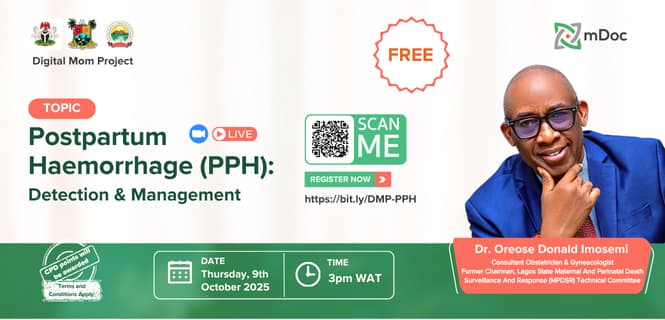
As part of the Digital Mom Project, a scalable, whole-system quality model designed to improve maternal health outcomes in Nigeria, we hosted a tele-education session on Postpartum Hemorrhage (PPH) on October 9, 2025, in alignment with World PPH Day. This initiative not only honors the global call to action but also situates our work within Nigeria’s commitment to achieving SDG 3.1—reducing maternal mortality to fewer than 70 deaths per 100,000 live births by 2030. It also celebrates the launch of the current Guidelines on the Management of Postpartum Hemorrhage
The session was led by Dr. Oreose Donald Imosemi, a renowned Consultant Obstetrician and Gynecologist with over three decades of experience. Dr. Imosemi, who formerly chaired the Lagos State Maternal and Perinatal Death Surveillance and Response (MPDSR) Technical Committee, worked closely with the Federal Ministry of Health to develop national guidelines and policy documents, including the National Guideline for the Management of Postpartum Hemorrhage.
Funded by MSD for Mothers, the Digital Mom Project leverages virtual learning networks, digital nudges, and patient-centered reviews to transform advocacy into lifesaving action. The tele-education highlighted the critical importance of early detection and effective management of PPH in reducing maternal deaths.
PPH remains a leading cause of maternal mortality globally, responsible for an estimated 82,000 maternal deaths annually, around 25–28% of all maternal deaths (WHO, 2025), with the majority occurring in low- and middle-income countries like Nigeria, which accounts for 19% of global maternal deaths as reported by the FMOH in 2019. In Nigeria, where the Maternal Mortality Ratio (MMR) stands at 1,047 per 100,000 live births, PPH is a major public health crisis.
During the session, Dr. Imosemi emphasized that beyond fatal outcomes, PPH can result in severe postpartum anemia requiring transfusion (affecting about 12% of cases), multisystem organ failure, clotting dysfunction, and intractable cases leading to hysterectomy, each with lasting impacts on fertility, mental health, and quality of life (WATOG 2025; WHO 2025).
Improving care before, during, and after birth to prevent PPH and its complications is essential to achieving SDG 3.1 and ensuring that no woman dies giving life.
In this blog post, we’ll share key insights from the session alongside new WHO guidelines on PPH (FIGO 2025) and explore how digital tools like the CompleteHealth™ app can empower healthcare providers and women alike to monitor and improve maternal health outcomes across Nigeria.
What is Postpartum Hemorrhage?
The World Health Organization (WHO) defines Postpartum Hemorrhage (PPH) as blood loss of 500 ml or more from the genital tract following childbirth. However, this threshold may underestimate true loss, as smaller volumes can still be clinically significant—particularly for women with anemia or pre-existing cardiac conditions.
During the session, the key focus areas included understanding the definition, classification, and clinical relevance of PPH. Dr. Imosemi highlighted that accurate classification is essential to guide timely recognition, escalation, and management. The discussion centered on:
- Primary PPH: Occurs within the first 24 hours after childbirth.
- Secondary PPH: Significant bleeding that occurs between 24 hours and six weeks postpartum.
- Based on Volume:
- Minor: 500–1,000 ml
- Major (Moderate): 1,000–2,000 ml
- Major (Severe): Greater than 2,000 ml
This classification aligns with recent WHO guidelines (2025), which highlight the importance of early recognition and prompt management of PPH to prevent severe complications and maternal deaths.
Risk Factors for PPH
Although the majority of women who experience Postpartum Hemorrhage (PPH) have no identifiable risk factors, various physiological and clinical factors can influence its occurrence. Importantly, most maternal deaths due to PPH are preventable through simple, evidence-based, and effective interventions that should be accessible to every woman. These include active management of the third stage of labour, the use of uterotonics, tranexamic acid, balloon tamponade, systematic devascularization, uterine artery embolization, and hysterectomy when necessary (FIGO, 2022).
Dr. Imosemi emphasized that all pregnant women should be considered at risk, underscoring the need for preventive measures that begin from preconception through the postpartum period. Supporting this, a 2023 study in the American Journal of Obstetrics & Gynecology found that a family history of PPH significantly increases risk, highlighting the importance of personalized care plans to ensure timely prevention and management.
Prevention of PPH: An Imperative
Prevention begins with quality antenatal care (ANC). The World Health Organization (WHO) recommends eight ANC contacts, with at least four distributed across the pregnancy journey. Quality ANC enables early detection of complications and includes risk classification, iron supplementation, hookworm treatment, and antimalarial prophylaxis. Ensuring delivery by skilled birth attendants in equipped health facilities is equally critical, alongside prompt referral systems for emergencies.
Early preventive approaches have focused on reducing uterine atony, the leading cause of PPH. The Active Management of the Third Stage of Labor (AMTSL), which involves the administration of uterotonic drugs such as oxytocin immediately after delivery, is recommended for all women, regardless of risk profile.
The WHO’s 2025 Consolidated Guidelines reinforce these practices, advocating the routine use of uterotonics and emphasizing the importance of low-cost, high-impact interventions, particularly in resource-limited settings. Addressing systemic barriers such as the three delays model—delays in decision-making, transport, and logistics (including cold-chain management), and receiving timely care remains vital for improving outcomes and strengthening maternal health systems.
Detection and Management of Postpartum Hemorrhage (PPH)
As highlighted by the speaker, Early detection of PPH is critical to saving lives. It is typically identified by persistent excessive vaginal bleeding after delivery, often accompanied by large clots, pallor, dizziness, or changes in vital signs. Because visual estimation of blood loss is unreliable, the WHO recommends calibrated drapes or collection bags for accurate measurement. The Shock Index (>0.9) is also a useful tool for early recognition of hemodynamic instability.
Effective management of PPH requires a systematic, multidisciplinary approach. Immediate steps include calling for help, assessing airway, breathing, and circulation (ABC), establishing IV access, and catheterizing the bladder. The WHO-endorsed E-MOTIVE bundle provides a structured framework for rapid response:
- E: Estimation of blood loss (using calibrated drapes)
- M: Massage the uterus
- O: Oxytocic agents (e.g., oxytocin, carbetocin)
- T: Tranexamic acid (1 g IV)
- I: IV fluids for resuscitation
- V: Vaginal examination for injuries or retained tissue
- E: Escalate if needed (e.g., Non-pneumatic Anti-Shock Garment, referral)
The E-MOTIVE bundle represents WHO’s first consolidated global framework for the early detection and management of PPH, an essential step toward reducing preventable maternal deaths worldwide.
Complications and Conclusion
If Postpartum Hemorrhage (PPH) is not promptly managed, it can lead to death within hours. Short-term complications include anemia, hypovolemic shock, multi-organ failure, and thromboembolism, while long-term effects may involve Sheehan’s syndrome, infertility, or sepsis following emergency interventions.
Yet, PPH is both preventable and manageable. The key lies in quality antenatal care, skilled birth attendance, efficient referral systems, and continuous provider training. Regular drills and adherence to clinical protocols strengthen readiness and response.
Through the Digital Mom Project, we are empowering women and healthcare providers with digital tools such as CompleteHealth™ and NaviHealth.ai™ is driving real-time learning and coordinated care. By amplifying women’s voices and improving health systems, Nigeria can significantly reduce maternal mortality and move closer to achieving SDG 3.1, ensuring no woman dies giving life. If you haven’t already, sign up on CompleteHealth™ to get personalized healthcare support.
References
- National Guideline for the Management of Postpartum Hemorrhage, Federal Ministry of Health, Nigeria (2025).
- Burden and outcomes of PostPartum hemorrhage in Nigerian tertiary hospitals, BJOG (2024).
- Consolidated guidelines for the prevention, diagnosis, and treatment of PostPartum Hemorrhage, WHO (2025).
- Causes of and risk factors for postpartum hemorrhage, The Lancet (2025).
- Family history of postpartum hemorrhage is a risk factor for postpartum hemorrhage after vaginal delivery, AJOG
MFM (2023).
- WHO recommendations on the assessment of postpartum blood loss and use of a treatment bundle for postpartum hemorrhage, WHO (2023).
- Global health agencies issue new recommendations to help end deaths from postpartum hemorrhage, WHO (2025).
Snapshot from the session

